AI is reshaping global trade at remarkable speed. The value of AI-enabling goods traded worldwide has doubled since 2014, rising from USD 1.9 trillion to USD 3.8 trillion in 2025. Behind this expansion lies a complex global value chain spanning raw materials and semiconductors to cloud services. This rapid growth raises an important question: is investment in AI infrastructure keeping pace with real demand?

AI and global trade: identifying the risks and opportunities
October 19, 2026
Trade credit insurance
Trade credit insurance protects your account receivables enabling you to trade, expand domestically and abroad without the risk of bad debt.
At Allianz Trade, we monitor industry-specific drivers such as cloud and data-center revenues, demand for semiconductors and optical fiber, and the construction pipeline for new facilities. These indicators help us assess whether supply is developing in line with demand, and where credit risks may be emerging.
Is the AI boom becoming a supply-chain risk?
To understand the AI sector and its risks, we first need to look at the businesses and infrastructure supporting it, before considering how quickly the technology is being adopted and monetized.
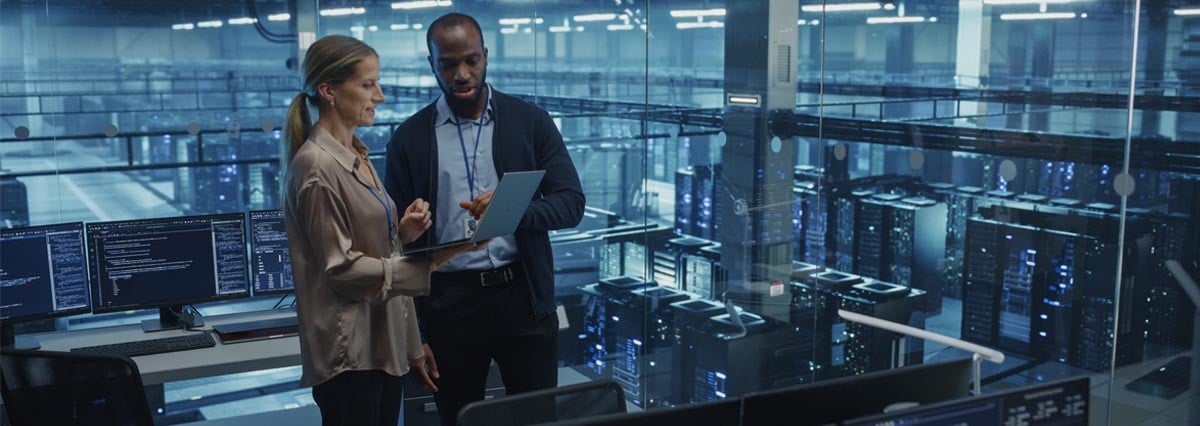
The AI ecosystem includes companies developing large language models (LLMs) and applications, semiconductor manufacturers, data-center operators, cloud-service providers and the energy and cooling businesses that keep this infrastructure running. The question is where these different parts of the value chain are located.
The supply chain for AI-related goods is highly concentrated. Asia accounts for around 65% of these exports (in value), according to Allianz Trade’s analysis, with China, Taiwan, Hong Kong and South Korea among the leading exporters of AI-related goods. Advanced semiconductors, memory chips and semiconductor equipment are produced by a limited number of companies, whose inability to cover rising demand inflate AI trade value.
In 2025, we identified data centers and their critical components as the parts of the AI value chain benefiting most from the surge in private investments that started in 2023 – but also as the most vulnerable segment if investment were to run ahead of demand. Since then, infrastructure investment has continued, while the concentration of semiconductor production has become an increasingly important source of vulnerability for the entire AI ecosystem.
Semiconductors are at the heart of AI’s potential because they provide the computing power and memory required to train and improve AI models. They are currently the most critical piece of the AI infrastructure cycle, accounting for roughly 50% of new data center added value.
As a result, semiconductors have become a strategic pillar of the global economy and have not escaped the recent global political fragmentation. Semiconductors are increasingly viewed as a matter of national sovereignty, as controlling their production can help countries secure supply and reduce strategic dependencies. This is particularly important in the context of AI. Semiconductor companies are both key beneficiaries of AI investment and major investors themselves, helping to reinforce the cycle of spending across the broader AI ecosystem.
The US has around 55 gigawatts of data-center power capacity – approximately six times more than Europe – and benefits from strong private investment, notably from hyperscalers whose spending is expected to outpace USD 700bn this year and surpass USD 1tn by 2028. Europe, by contrast, is in a weak spot because its AI gains rely heavily on external markets: the US for cloud services and Asia for hardware components and devices.
Factors that could burst the AI bubble
We’ve identified several non-technology factors that may constrain AI’s expansion in the near future. For example, data centers require large amounts of electricity and high-performance cooling systems to run a full capacity on a permanent way without suffering disruptions. In parts of Europe, connecting a new facility to the national grid can involve waiting for around seven to 10 years. Regulatory blockages, local opposition and access to sufficient infrastructure add another layer of challenges for companies, which have to find alternative solutions to overcome these barriers.
Water availability is another concern, particularly in southern European countries – there, companies have been directly affected by climate change over the past few years. As data centers generate significant heat, they need cooling systems that can operate reliably during periods of high temperatures that are expecting to become more frequent in the future.
These physical constraints are reinforcing the importance of monitoring companies’ resilience to geopolitical risks. Control over data centers, cloud capacity and data flows are becoming sources of influence, while restrictions on cross-border data and digital services can make it harder for companies to operate internationally.
Identifying trade credit risks
Export controls, subsidies and other industrial policies are gradually reshaping where semiconductors are manufactured and how technology is exchanged. The result is a supply chain that’s becoming more geographically distributed in some areas, while remaining more concentrated at the technological frontier.
Businesses operating in this sector need to assess whether AI-related revenue is translating into profit. Developing and deploying AI technology is costly, and investors will eventually expect a return on their investments along with more visibility on cashflow timeline.
Warning signs include rising debt, continued negative free cash flow, excessive customer concentration and business models that depend on sustained premium pricing. Companies’ exposure to a small number of suppliers, technologies or countries is another factor to keep an eye on.
The most resilient businesses may be those supporting the wider AI ecosystem rather than relying on a single model or application. Energy and grid-related companies, power-generation and storage providers and businesses developing water-efficient cooling systems could benefit from long-term demand for computing capacity. Going forward, “enabler” industries like robotics, electronic hardware or autonomous mobility that translate computing capacity into physical assets and mass-market consumption hardware also look well positioned to benefit from broader AI adoption in the long term.
Building resilience in the AI economy
AI’s potential depends on a complex and highly concentrated global infrastructure. For companies trading in or around the AI sector, the lesson is to look beyond headline growth figures. At Allianz Trade, we look closely at who companies rely on, who their customers are and whether their growth is financially sustainable – helping businesses understand the risks and empowering them to trade with confidence in the AI economy.
At the same time, the AI boom is creating opportunities well beyond the technology sector. Companies that invest carefully and build resilient supply chains will be well placed to benefit from AI’s long-term potential.
Got questions?
Connect with our expert ↓
Connect with our expert ↓

Guillaume Dejean
Senior sector analyst
Allianz Trade
Frequently Asked Questions
The AI boom refers to the rapid increase in investment, adoption and expectations surrounding artificial intelligence. This includes the development of AI models and the infrastructure needed to support them. Some parts of the AI value chain may be overheated, particularly where investment is based on uncertain future demand. However, AI has real applications both at the consumer and corporate level. The key question is whether current infrastructure investment is proportionate to the demand that will eventually use it.
AI is increasing demand for semiconductors, data-center equipment, energy and digital services. It is also reinforcing the importance of a small number of countries and companies, while export controls and data regulations are creating barriers to trade.
Businesses should look at how exposed their partners are to risks such as supply chain concentration, rising input costs and changing regulations. They should also keep a close eye on financial health, including whether AI-related customers are profitable, generating cash or taking on too much debt.