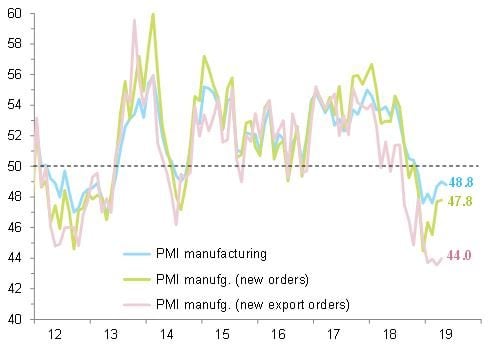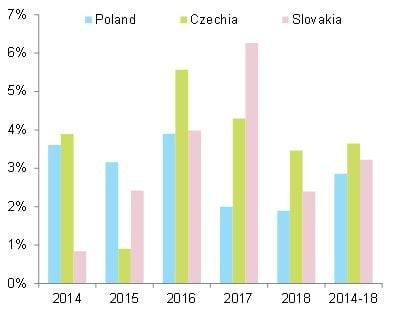

- Over the past five years, Poland experienced rapid economic growth of an average annual rate of +4%, driven by strong foreign demand, an investment boom and a markedly strengthening labor market. However, while the latter two should persist in 2019, foreign demand (notably from the Eurozone) has already begun to weaken. As a result, we expect a slowdown of Poland’s growth from +5.1% in 2018 to +4% in 2019 and +3.3% in 2020 amid an increasingly challenging global economic environment.
- Risks in the corporate sector are expected to rise. Even though the Days Sales Outstanding (DSO) of listed companies indicate that large firms are enjoying relatively good payment discipline, the overall non-payment risk has steadily risen over the last three years. This is reflected in the ongoing uptrend in business insolvencies (+10% p.a. on average in 2016-2018). We expect corporate insolvencies to increase by another +10% in 2019, posing particular risks to large-scale suppliers of Polish companies.
- Despite the boom over the past five years, policy choices have led to a deterioration in the attractiveness of doing business in and with Poland. Feuds between the Polish government and the EU may even put future EU funding flows at risk. Thus, the best days in terms of strong economic performance could be behind for Poland. However, there are opportunities and room for maneuvering for the next government to reverse those critical policy moves and improve the overall business and investment climate.
EU impetus and investment growth drove the recent boom
Poland experienced a strong economic rebound between 2014 and 2018, with real GDP expanding by an average annual +4% and reaching an 11-year peak of +5.1% in 2018. Three key factors drove the strong performance:
- Strong foreign demand
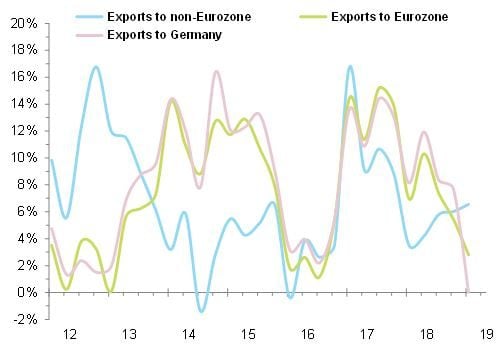
Poland’s real exports grew by an average annual rate of +7.8% between 2014 and 2018, thanks to the Eurozone recovery, as shipments to the member states of the monetary union, especially Germany, rose much more than those to the rest of the world (see Figure 1). The Eurozone’s share in Polish goods exports increased from 51.6% in 2013 to 57.7% in 2018 (Germany’s share rose from 25.1% to 28.2% over the same period). Polish companies benefited from the supply-chain structures that were built up over the past two decades.