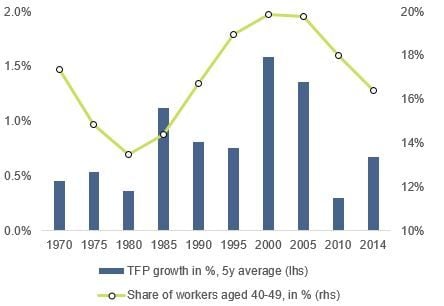
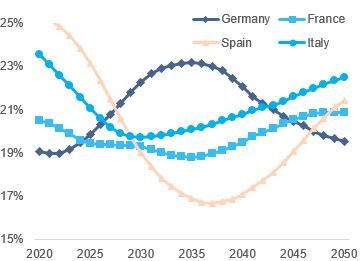
The most productive and innovative workers in the U.S. seem to be the ones aged between 40 and 49. The median innovator, for example, is aged 47. Moreover, most patents are filed by workers aged between 40 and 49 and this age bracket also shows the best adaptability to new technologies within the total workforce (Klein 2019).
Does this close relation between the age structure of the workforce and productivity growth also apply to European countries? Will Millennials restore Europe’s labor productivity and secure prosperity?
Demographic change and productivity in Europe
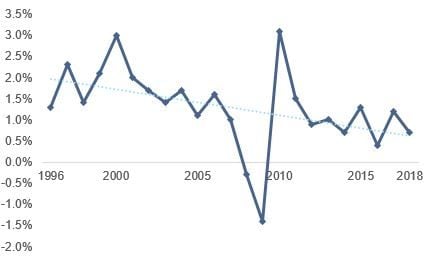
Labor productivity growth has slowed in almost all European countries over the last two decades as shown by Figure 1. Only Ireland and Spain managed to buck this trend, but for different reasons: In Ireland, a quirk in national accounts in 2015 gave an artificial boost to productivity growth, turning a slightly declining trend into a slightly increasing one. And in Spain, a short-lived productivity spurt after the financial crisis helped to lift the trend. Since then, however, productivity growth has continuously fallen again.
However, there is a clear East-West divide in terms of growth levels (see Figure 3). In Eastern Europe, productivity growth has been elevated in all countries, especially in the Baltic states and Romania, where the average growth rate topped +4%. Only Croatia and Hungary lagged slightly behind, but they were still well ahead of Western European countries. After the end of communism, the reintegration of these markets into European value chains implied huge inflows of investments and a positive technological shock. Even if only the last ten years are taken into account, most Eastern European countries still boast higher productivity growth than Western ones, though the differences have become smaller.
The only Western European country with comparably high productivity growth is Ireland, which has benefitted from its role as the preferred investment destination for American tech firms. Other Western European countries have mostly recorded lackluster growth rates below +1%; only Sweden fared a little better, with an average of +1.5% over the last two decades. At the bottom of the table are Luxembourg – its focus on finance bodes ill for productivity growth – and Italy: Here, productivity itself has in fact declined, the result of a permanent denial of the need for structural reforms. Surprisingly, in Germany, too, productivity growth has disappointed, mainly because of a relatively backward service sector. France performed slightly better than Germany. Overall, the differences between Western European countries are small and do not alter the general verdict: Productivity growth in Western Europe is a fiasco.
To test whether the changing age structure of the European workforce has an impact on this, we made a panel data study including the EU28 countries. We used data from Eurostat to allow our estimators to disengage the effect of un-observables within the countries, such as cultural differences and transitions in and out of states (poverty, workforce, etc.). We regressed the share of workers in their 40s, 30s and 20s on labor productivity, controlling for individual country characteristics for the years observed.
For Europe as a whole, our model yielded statistically significant results: A higher share of workers in their 30s and their 40s increases productivity growth by 16pp and 17pp, respectively, if we isolate the effect of aging. Of course, productivity paths differ from industry to industry and from job profile to job profile, so the channels through which the age structure of the workforce can affect productivity growth are manifold. Identifying them is beyond the scope of this paper. Our aim is simply to prove that age structures have an impact – which they clearly do.
At a country level, the picture is a little murkier. For some of the countries in our sample, our model on workforce structure and aging was not significant. This was the case for Denmark, Luxembourg, Norway and Sweden, as well as Poland. For Poland, rapid technological advances might have overshadowed age-related factors; in Luxembourg, the monoculture of finance might have had a similar effect. For the three Scandinavian countries, other reasons like relatively stable demographics might have played a role.
However, for the overwhelming majority of countries, we could prove a statistically significant impact of age structures on productivity growth, albeit at different levels: gains in productivity by a marginal increase in the share of workers aged 40-49 are not the same across the board. In Southern Europe, for example, namely Greece, Spain and Portugal, the impact is low, i.e. below 0.2pp; the same applies to Belgium, the Czech Republic, Estonia, the UK and the Netherlands. Meanwhile, France, Italy, Finland, Slovakia, Latvia and Switzerland show average gains in productivity, with an increase from 0.2 to 0.4pp if the share of workers aged 40-49 increases. However the countries that benefit the most, according to our estimations, are Hungary, Ireland, Germany, Austria and Slovenia, which show an increase of more than 0.4pp in their productivity growth.
To sum up: What Feyrer could show for the US – the overwhelming impact of the share of 40-somethings in the workforce on productivity growth – is also observable in Europe: The age cohort of 40-49 defines to a certain degree the trajectory of productivity growth. This means productivity doesn’t have to suffer because of a declining workforce or darkening economic prospects: If aging leads to a better age structure, i.e. a relatively higher share of workers aged 30 to 49, it could even improve.
The flip side is that some European countries are especially vulnerable if demographics turn less favorable.
A demographic dividend for productivity growth?
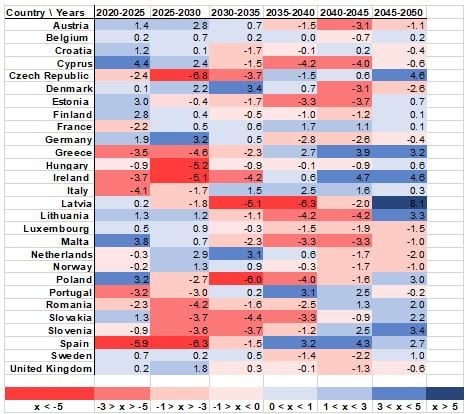
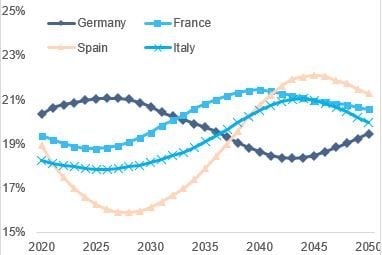
By combining our results with (reliable) demographic forecasts, we can chart the prospective growth rates of labor productivity in European countries.
The heat map (see Table 1) visualizes the forecasted demographic development divided into five-year intervals. Here, each value (x) has been calculated by adding the increase / decrease in both the share of workers aged 30 to 39 as well as 40 to 49 in percentage points between five years intervals (2020-2025, 2025-2030, etc.). To avoid an “equalization effect” between the two shares (e.g. an increasing share of 30 to 39 and a decreasing share of 40 to 49 cancelling each other out) and to consider the higher correlation of workers in their forties, the percentage point change of the age cohort 40 to 49 years has been rated with the factor 1.5 while the factor 1.0 has been assigned to workers in their thirties. The higher the final value, the higher the increase in the share of workers aged between 30 and 49, and hence the higher the positive impact on the growth rate of labor productivity in each country, and vice versa.